Crazyrouter
AI API Pricing Comparison 2026: OpenAI, Claude, Gemini, DeepSeek, and Routing
Compare AI API pricing in 2026 using input, output, caching, batch jobs, and routing costs.

AI API Pricing Comparison 2026: OpenAI, Claude, Gemini, DeepSeek, and Routing#
Compare AI API pricing in 2026 using input, output, caching, batch jobs, and routing costs. In 2026, the hard part is rarely sending the first request. The real engineering work is choosing the right model, keeping credentials safe, measuring cost per successful result, and making failures recoverable. This article focuses on those production concerns and uses AI API pricing comparison 2026 as the organizing topic.
What is AI API pricing comparison 2026?#
AI API pricing comparison 2026 describes a developer workflow rather than a single button or benchmark. A useful implementation has four layers: an application layer, a provider adapter, a policy layer for model and budget selection, and observability for latency, tokens, errors, and outcomes. Keeping these layers separate lets you change providers without rewriting the product.
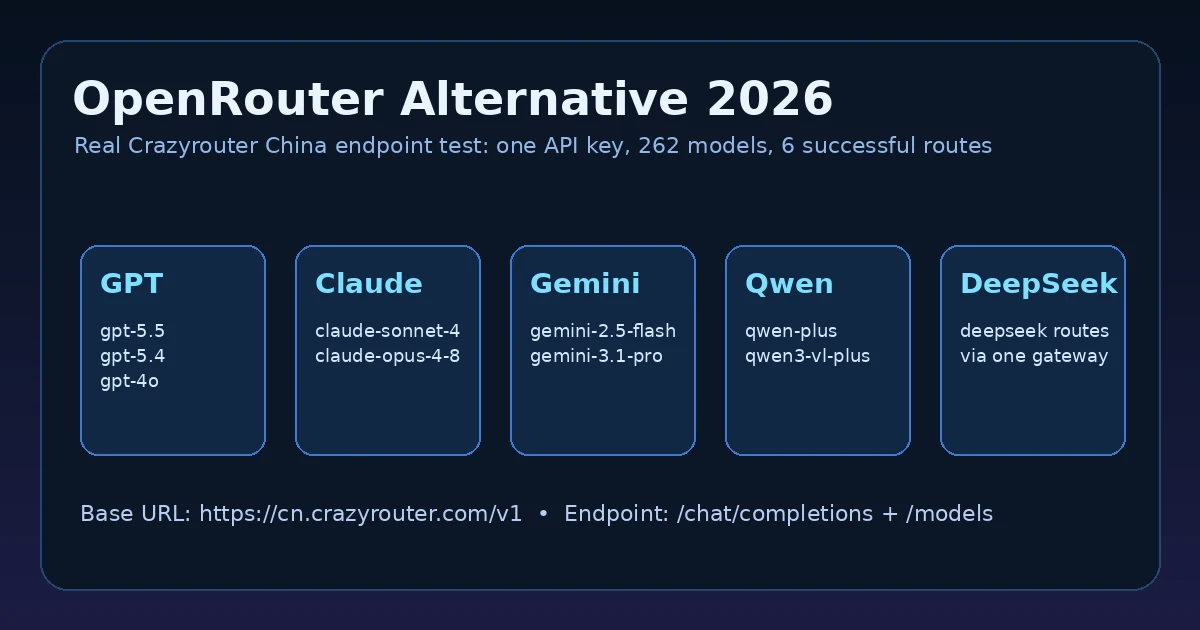
For teams that need one interface to many models, Crazyrouter provides an OpenAI-compatible gateway plus Anthropic and Gemini-compatible access. It is useful when you want to test several models with one key and compare the actual cost of a workflow.
AI API pricing comparison 2026 vs common alternatives#
The direct-provider approach is simple and gives you first-party features, but every provider introduces different authentication, limits, error formats, and billing dashboards. A gateway reduces integration work and makes fallback routing practical. Self-hosted projects such as LiteLLM offer control, but you operate the proxy, provider credentials, limits, and monitoring yourself.
| Approach | Best for | Main advantage | Main trade-off |
|---|---|---|---|
| Direct provider SDK | One-model prototypes | First-party features | Vendor lock-in and separate billing |
| Self-hosted gateway | Platform teams | Maximum infrastructure control | You operate reliability and updates |
| Managed gateway | Multi-model products | One key and usage visibility | Review policies and margins |
| Crazyrouter | Fast multi-model development | OpenAI-compatible access to many model families | Verify live availability and pricing |
Choose based on your bottleneck: experimentation, compliance, latency, or operating cost. Do not choose only by the lowest token price. A cheap model that needs retries or produces unusable output can cost more per completed task.
How to use it with code#
The Python example uses the OpenAI client shape. Keep the key in an environment variable and never commit it to source control.
import os
from openai import OpenAI

client = OpenAI(api_key=os.environ["CRAZYROUTER_API_KEY"], base_url="https://crazyrouter.com/v1")
response = client.chat.completions.create(
    model="gpt-5-mini",
    messages=[{"role": "user", "content": "Return a concise JSON status report."}],
    temperature=0.2,
)
print(response.choices[0].message.content)
Node.js uses the same contract:
import OpenAI from "openai";
const client = new OpenAI({ apiKey: process.env.CRAZYROUTER_API_KEY, baseURL: "https://crazyrouter.com/v1" });
const result = await client.chat.completions.create({
  model: "gpt-5-mini",
  messages: [{ role: "user", content: "Summarize this deployment log." }]
});
console.log(result.choices[0].message.content);
For a smoke test, cURL is enough:
curl -s https://crazyrouter.com/v1/chat/completions -H "Authorization: Bearer $CRAZYROUTER_API_KEY" -H "Content-Type: application/json" -d '{"model":"gpt-5-mini","messages":[{"role":"user","content":"ping"}]}'
In production, add a request ID, timeout, exponential backoff with jitter, and an idempotency strategy for retryable jobs. For streaming, record time-to-first-token separately from total latency. For batch work, put a queue in front of the provider and enforce a per-tenant budget before dispatch.
Pricing breakdown#
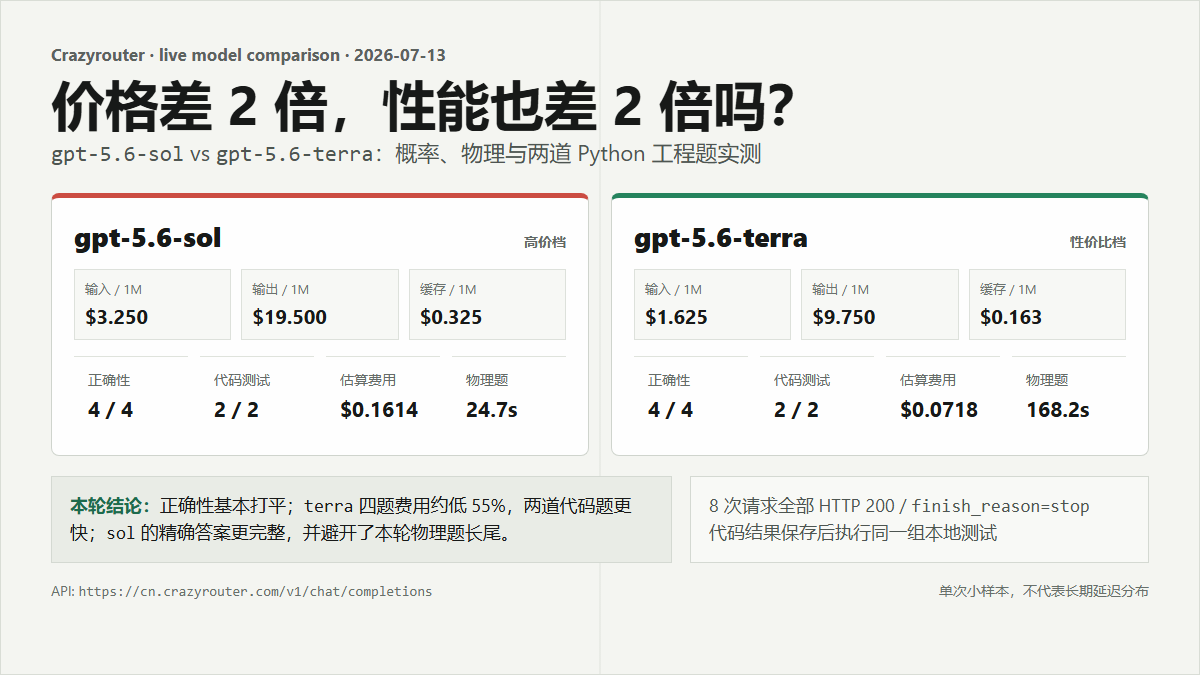
Prices change frequently, so treat this as an engineering comparison rather than a permanent quote. Official providers commonly publish separate input, output, cached-input, and batch rates. A gateway may expose a different effective price, so check the live Crazyrouter pricing page before launch.
| Cost component | Official API pattern | Gateway planning rule |
|---|---|---|
| Input tokens | Metered per million tokens | Track by model and tenant |
| Output tokens | Usually more expensive | Set max output and stop conditions |
| Cached prompts | Often discounted | Cache stable system and tool context |
| Batch jobs | Often discounted | Queue non-urgent work |
| Retries | Usually billed again | Retry only transient failures |
| Routing overhead | Not always visible | Measure cost per successful task |
A simple monthly estimate is: requests × average input tokens × input rate + requests × average output tokens × output rate. Add a retry factor, then compare it with the cost of a completed business outcome.
Production checklist#
- Start with one reliable model and a small evaluation set.
- Add a cheaper model only after measuring quality on your prompts.
- Store provider and model names with every request.
- Apply tenant quotas, maximum output tokens, and timeouts.
- Redact keys and sensitive prompt fields from logs.
- Add fallbacks only for errors that are safe to retry.
- Review cost and quality weekly, not just total spend.
FAQ#
Is AI API pricing comparison 2026 suitable for production?#
Yes, if you add timeouts, quotas, monitoring, secret management, and an evaluation set. A successful demo is not a reliability design.
Is a gateway always cheaper than the official API?#
No. Effective cost depends on model, discounts, routing, retries, and workload. Compare live prices and cost per successful result.
Can I switch models without rewriting my app?#
Usually, when you use a compatible chat schema and avoid provider-specific features. Keep adapters for tools, vision, audio, and structured output where behavior differs.
How should I protect API keys?#
Use environment variables or a secret manager, restrict scope and IPs where possible, rotate regularly, and never place keys in browser code.
What should I measure first?#
Measure success rate, latency percentiles, input/output tokens, retry rate, and cost per successful task.
Summary#
AI API pricing comparison 2026 becomes easier to operate when pricing, routing, reliability, and security are designed together. Start small, measure real workloads, and keep the provider boundary replaceable. To test multiple model families through one API surface, visit Crazyrouter and compare the current model catalog and pricing.